
Friendly Note: TheInspiringSouls.com shares general info for curious minds 🌟 Please fact-check all claims and always check health matters with a professional 💙
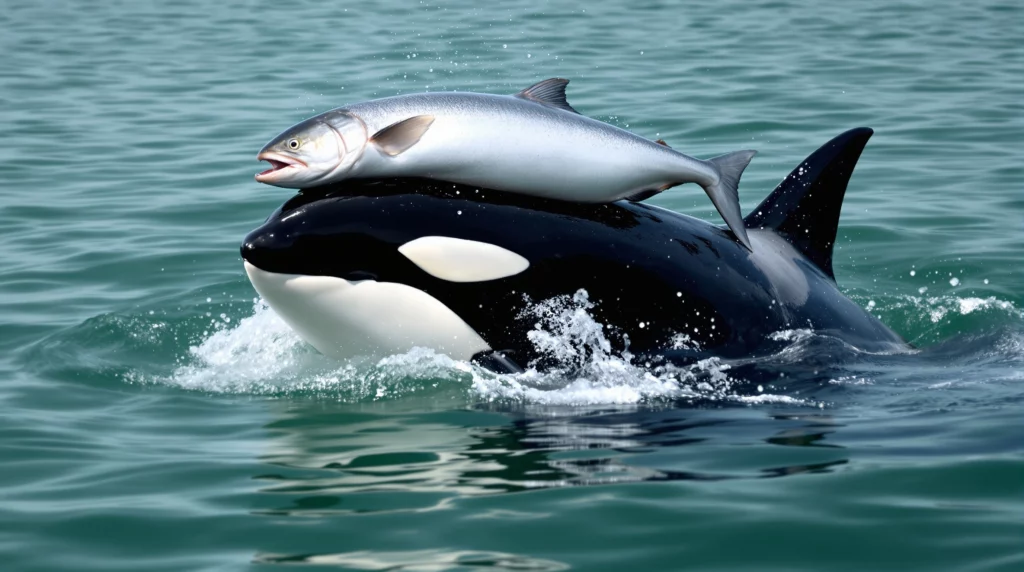
Picture this: you’re watching the ocean when suddenly, a group of magnificent orcas surfaces nearby. But something looks… unusual. One of them appears to be wearing what looks like a hat made from a dead salmon, perfectly balanced on its sleek black head. Sound like something out of a fantasy movie? Well, this bizarre behavior is very real, and it’s making headlines again after disappearing for nearly four decades.
The ocean’s most intelligent predators have always surprised us with their complex behaviors, but few are as puzzling as this peculiar “fashion statement.” What makes this phenomenon even more extraordinary is its mysterious timeline and the questions it raises about animal culture and intelligence.
A Strange Fashion That Vanished Into the Deep
Back in 1987, marine biologists working in the Pacific Northwest witnessed something they’d never seen before. Orcas were deliberately placing deceased salmon on their heads while swimming, carrying their unusual cargo for extended periods. This wasn’t accidental or clumsy behavior. The fish were carefully positioned and maintained, suggesting a purposeful action that researchers quickly dubbed the “salmon hat” phenomenon.
The behavior spread rapidly among the southern resident orca population in the Puget Sound area. For about a year, multiple individuals were spotted sporting these fishy headpieces. Then, just as mysteriously as it had appeared, the trend vanished by 1988. For 37 years, not a single confirmed sighting was recorded.
Marine biologist Deborah Giles, who has spent nearly two decades studying these magnificent creatures, recalls the rarity of witnessing such behavior. “It’s been a while since I’ve personally seen it,” she noted, highlighting just how uncommon and fleeting this phenomenon proved to be.
The Unexpected 2024 Revival
Fast-forward to 2024, and the salmon hat trend has made a surprising comeback. Reports began surfacing of orcas once again balancing dead fish on their heads in the same Pacific Northwest waters where the behavior first emerged. The timing couldn’t be more intriguing, especially considering that an entire generation of orcas has been born and matured since the last documented cases.
However, the revival comes with important caveats. While viral photos on social media suggested a widespread resurgence, experts urge caution about the actual scale of the phenomenon. Some researchers have documented only a handful of verified cases, emphasizing that the behavior remains sporadic rather than widespread.
The question that has everyone scratching their heads is simple yet profound: how did this behavior return after such a long absence? Did some older orcas remember and pass it down, or did younger generations independently rediscover this peculiar practice?
Unraveling the Mystery Behind the Behavior
Scientists have proposed several fascinating theories to explain why orcas engage in this seemingly pointless activity. The most compelling explanation centers around food abundance. When salmon populations are particularly high, orcas may have surplus catch that leads to experimental or playful behaviors. It’s as if they’re saying, “We have so much food, we can afford to play with it.”
Orca behavior specialist Andrew Foote proposes that mature whales who witnessed this practice during the 1980s could be responsible for its reemergence. “There’s a reasonable chance that certain individuals who were present during the original occurrence might have reintroduced this behavior,” he observed.
The playfulness theory is particularly compelling when you consider the remarkable intelligence and sophisticated social interactions these marine mammals demonstrate. Much like dolphins playing with seaweed or creating bubble rings, this fish-wearing behavior could be an elaborate form of entertainment or social bonding. It might even serve as a display of dexterity or status within the pod’s social hierarchy.
Giles draws interesting parallels to other orca behaviors: “We’ve observed carnivorous killer whales transport substantial food portions beneath their pectoral fins, essentially secured against their bodies.” This tendency to manipulate objects suggests that orcas have a natural inclination for experimentation and play, behaviors strongly linked to high intelligence in animals.
A Window Into Orca Culture
What makes the salmon hat phenomenon truly remarkable is what it reveals about orca culture and social learning. Like humans, orcas learn behaviors through social interactions in a process called cultural transmission. They’ve previously demonstrated learned behaviors such as specialized hunting techniques and unique vocal dialects specific to different pods.
The ability to revive a behavior after nearly four decades speaks volumes about the complexity of orca memory and cultural preservation. Whether younger generations rediscovered this trend through their own experimentation or inherited it from long-standing traditions, the salmon hat behavior showcases their advanced social structures and remarkable memory capabilities.
Foote anticipates that extended monitoring will provide additional understanding: “With continued observation, researchers might accumulate sufficient data to demonstrate that, for example, an individual maintained a fish on its head for approximately half an hour before consuming it.” Such detailed documentation could help researchers understand the practical aspects of this behavior.
The Salmon Connection
To truly understand this phenomenon, we need to consider the crucial relationship between orcas and salmon. Southern resident orcas depend heavily on salmon, particularly Chinook and chum species, for their survival. Their diet is so specialized that salmon availability directly impacts their health, reproduction, and behavior.
Years of high salmon abundance have been linked with the emergence of new or experimental behaviors in orcas. When food scarcity pressures are reduced, these intelligent mammals have more energy and time to engage in non-essential activities like play or cultural expression. This connection between salmon abundance and behavioral experimentation adds another layer to understanding why the salmon hat trend might resurface during specific environmental conditions.
However, it’s important to note that any temporary improvement in prey abundance doesn’t negate the long-term threats facing both salmon populations and orcas. Issues like dam construction, overfishing, pollution, and habitat destruction continue to pose significant challenges to these interconnected species.
The Challenge of Scientific Documentation
One of the biggest hurdles in studying the salmon hat phenomenon is the challenge of reliable observation and documentation. Much of orca behavior occurs beneath the surface or far from human observers, making consistent monitoring difficult. When dramatic images surface on social media, they can create the impression that behaviors are more common than they actually are.
This is where the expertise of researchers like Deborah Giles becomes crucial. Having observed orcas for 19 years, she provides important context about the true frequency of these behaviors. Her emphasis on seeing the phenomenon only “a handful of times” helps ground the discussion in scientific reality rather than viral speculation.
The role of citizen scientists, whale-watching communities, and marine biologists in documenting these behaviors cannot be overstated. However, it’s equally important to distinguish between confirmed observations and unverified reports that can spread rapidly through social media.
Conservation Implications
While the salmon hat behavior might seem like a lighthearted curiosity, it actually has serious implications for marine conservation. Understanding the cultural lives of orcas helps researchers advocate for protections that preserve not just their physical habitat, but also the environmental conditions necessary for their rich social behaviors to flourish.
The southern resident orca population faces numerous threats, and their specialized diet makes them particularly vulnerable to changes in salmon availability. By studying behaviors like the salmon hat phenomenon, scientists gain insights into how environmental conditions affect orca culture and social dynamics.
Moreover, such behaviors serve as potential indicators of ecosystem health. A resurgence in playful behaviors might reflect temporarily improved prey abundance, offering hope while reminding us of the ongoing need for comprehensive conservation efforts.
What the Future Holds
As we look ahead, the salmon hat phenomenon continues to captivate both scientists and the public. Whether this trend will persist, spread, or vanish again remains to be seen. What’s certain is that continued observation and documentation will be crucial for understanding not just this specific behavior, but the broader principles of animal culture, intelligence, and social learning.
The mysterious motivations behind orcas’ decision to balance dead fish on their heads may never be fully understood. As Giles honestly admits, “Your guess is as good as mine.” But perhaps that’s part of what makes this phenomenon so fascinating. It reminds us that even our most studied marine species still hold secrets and surprises.
The return of the salmon hat trend offers a unique window into the minds of these oceanic giants, challenging us to expand our understanding beyond traditional studies of hunting, communication, and migration. Whether driven by play, tradition, experimentation, or something else entirely, this behavior underscores the profound intelligence and cultural complexity of orcas.
In a world where human activities increasingly impact marine ecosystems, phenomena like the salmon hat serve as powerful reminders of what we stand to lose if we don’t prioritize the conservation of these remarkable creatures and their habitats. After all, a world without orcas wearing salmon hats would be a little less mysterious, a little less wonderful, and certainly a lot less inspiring.

