Friendly Note: TheInspiringSouls.com shares general info for curious minds 🌟 Please fact-check all claims and always check health matters with a professional 💙
Picture this: you’re floating in complete darkness, nearly five miles beneath the ocean’s surface, where the pressure would crush a human instantly. The water is freezing cold, and no sunlight has ever touched this place. Most people would assume nothing could possibly live here. They’d be wrong.
Deep in the Pacific Ocean, scientists have been exploring one of Earth’s most mysterious places. The Atacama Trench stretches along South America’s western coast like a massive underwater canyon. It’s one of the deepest spots on our planet, plunging down almost 26,000 feet below the surface.
For years, researchers have wondered what might be living in these extreme depths. The conditions seem impossible for life. The pressure down there is more than 800 times stronger than what we feel at sea level. There’s no light, very little food, and temperatures hover just above freezing. Yet every time scientists venture into these depths, they find life thriving in ways that seem to defy all logic.
A Chance Encounter in the Abyss
In 2023, a team of scientists from the United States and Chile decided to take a closer look at the Atacama Trench. They weren’t tourists on this trip. Using a research vessel called the R/V Abate Molina, they lowered a special piece of equipment called a lander vehicle nearly eight kilometers down into the trench.
Think of this lander as a deep-sea robot equipped with cameras, lights, and baited traps. It’s designed to sit on the ocean floor and wait patiently for whatever creatures might be curious enough to investigate. The scientists had no idea what they might find, if anything at all.
What they discovered would challenge everything we thought we knew about life in Earth’s deepest places.
When Four Becomes Everything
The lander captured just four small creatures during its time on the ocean floor. Four might not sound like much, but in the world of deep-sea research, finding even one new species is like striking gold. These weren’t just any ordinary deep-sea dwellers, though.
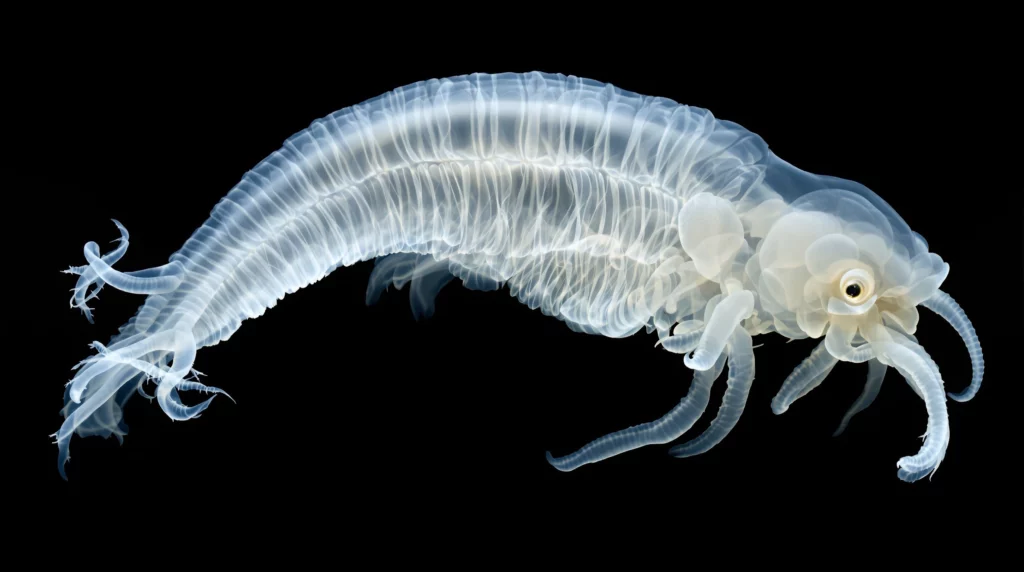
Back on the research vessel, the scientists carefully examined their catch. What they found was unlike anything they’d seen before. These creatures measured about 4 centimeters long, roughly the size of your thumb. They had ghostly white, almost translucent bodies that seemed perfectly adapted to their pitch-black world.
But it was their behavior that really caught the researchers’ attention. Most deep-sea creatures at these depths are scavengers, patiently waiting for food to drift down from the upper levels of the ocean. These creatures were different. They were active hunters, equipped with specialized appendages that looked almost alien in design.
Meet “Darkness” – The Deep Sea’s Newest Predator
After months of detailed analysis, including DNA testing and careful morphological studies, the scientists realized they’d discovered something extraordinary. This wasn’t just a new species, it was an entirely new genus that had never been seen before.
They named it Dulcibella camanchaca, though it’s earned a much more memorable nickname: “Darkness.” The name isn’t just poetic. “Camanchaca” means “darkness” in several indigenous languages from the Andes region, a perfect tribute to the creature’s home in the eternal night of the deep ocean.
Dr. Johanna Weston, a hadal ecologist at Woods Hole Oceanographic Institution, explained the significance of the name: “Dulcibella camanchaca is a fast-swimming predator named after ‘darkness’ in the languages of the Andes region, a homage to the deep, dark ocean where it preys.”
But what makes “Darkness” truly remarkable isn’t just its name or where it lives. It’s how it lives.
Built for Hunting in Hell
Most creatures that live in the deepest parts of the ocean have evolved to be patient. Food is scarce down there, so the best strategy is usually to conserve energy and wait for meals to come to you. “Darkness” took a completely different evolutionary path.
This creature is an active predator, equipped with what scientists call “raptorial appendages.” Think of them as specialized arms designed for one purpose: catching and killing prey. These appendages give the creature an almost alien appearance, something that might have crawled out of a science fiction movie rather than evolved in Earth’s oceans.
The creature’s entire body seems designed for hunting. Its streamlined shape allows it to move efficiently through the water, while its translucent white coloration helps it blend into the darkness. At depths where the pressure would instantly crush most surface creatures, “Darkness” swims around hunting other amphipods and small crustaceans like it’s just another day at the office.
Life in the Hadal Zone
To understand just how extraordinary “Darkness” really is, you need to appreciate the environment it calls home. The Atacama Trench exists in what scientists call the hadal zone, the deepest part of the ocean, starting at about 6,000 meters below the surface and continuing down to the ocean floor.
The hadal zone is like an alien world right here on Earth. The pressure at these depths reaches more than 16,000 pounds per square inch. To put that in perspective, it’s like having the weight of 50 jumbo jets pressing down on every square meter of your body. The temperature hovers just above freezing, and the only light comes from the occasional bioluminescent creature passing by.
Food is incredibly scarce. Most nutrition comes from “marine snow,” tiny bits of organic matter that drift down from the surface waters above. It can take weeks or months for this food to reach the hadal zone, and by the time it gets there, most of the nutrients have already been consumed by creatures living in the waters above.
Yet somehow, “Darkness” has not only survived in this environment but thrived as an active predator.
The Atacama Trench: Earth’s Final Frontier
The Atacama Trench itself is a geological wonder. Stretching approximately 3,666 miles along the western coast of South America, it’s one of the longest and deepest oceanic trenches on Earth. The deepest point, known as Richards Deep, plunges down 8,065 meters below sea level.
This massive underwater canyon was formed by the subduction of the Nazca Plate under the South American Plate, a process that’s still active today. The result is not just a deep trench, but an area of active volcanism and complex geological activity that creates a unique environment unlike anywhere else on Earth.
Dr. Carolina González, an oceanographer at the Universidad de Concepción and co-lead author of the research, noted the trench’s special significance: “This study’s collaborative effort and integrative approach not only confirmed Dulcibella camanchaca as a new species but also underscored the rich biodiversity of the Atacama Trench.”
Despite its extreme conditions, the trench sits beneath some of the ocean’s most nutrient-rich and productive surface waters. This creates an interesting paradox: a food-rich environment above and a food-limited environment below, separated by miles of crushing darkness.
What This Discovery Really Means
The discovery of “Darkness” is about much more than just finding a new species. It’s a reminder of how little we actually know about our own planet. Scientists estimate that over 95% of Earth’s oceans remain completely unexplored. The deep-sea trenches represent some of the least studied areas on Earth.
Every time researchers venture into these depths, they find life in places and forms that challenge our understanding of what’s possible. “Darkness” is particularly significant because it represents a completely different survival strategy than what scientists typically see at these depths.
The creature’s hunting lifestyle and specialized predatory adaptations suggest that the deep ocean’s food webs might be far more complex and active than previously thought. Instead of passive scavengers waiting for food to rain down from above, there might be entire ecosystems of active predators and prey engaged in the same kind of hunt-or-be-hunted dynamics we see in surface environments.
Implications Beyond Earth
The discovery of “Darkness” has implications that extend far beyond marine biology. As scientists search for life on other planets and moons, they’re particularly interested in places with conditions similar to Earth’s deep ocean trenches.
Jupiter’s moon Europa and Saturn’s moon Enceladus both have vast oceans beneath their icy surfaces. These oceans exist in perpetual darkness, under crushing pressure, and with limited food sources, conditions remarkably similar to the Atacama Trench. If complex predators like “Darkness” can evolve and thrive in Earth’s most extreme marine environments, what might be possible in the alien oceans of our solar system?
The creature’s specialized adaptations for surviving extreme pressure, darkness, and food scarcity could also inspire future technology. Engineers studying deep-sea creatures often find new approaches to designing underwater vehicles, pressure-resistant materials, and even spacecraft intended for exploring similar conditions on other worlds.
The Technology Behind the Discovery
Finding “Darkness” required some pretty incredible technology. The lander vehicle used in the 2023 expedition is essentially an untethered robot designed to survive one of the most hostile environments on Earth. It’s equipped with high-definition cameras, powerful lights, scientific instruments, and baited traps, all housed in a pressure-resistant shell that can withstand the crushing depths of the hadal zone.
The process of deploying the lander is a bit like dropping a scientific laboratory into an alien world and hoping it survives long enough to gather useful data. Once deployed, the lander operates independently on the ocean floor, using its lights and bait to attract whatever creatures might be living in the area.
When the research team recovers the lander, they never know what they might find in the traps. In this case, those four small specimens of “Darkness” represented months of careful analysis using DNA sequencing and detailed morphological studies to confirm that they’d discovered not just a new species, but an entirely new genus.
What Comes Next
The discovery of “Darkness” is just the beginning. As Dr. González noted in her research, “More discoveries are expected.” The Atacama Trench and other hadal environments around the world likely harbor countless species that science has never encountered.
Current research efforts are focused on better understanding the complex ecosystems that exist in these extreme depths. Each new discovery helps scientists piece together a more complete picture of how life evolves and survives in conditions that seem impossible.
These insights are crucial for more than just satisfying scientific curiosity. Understanding deep-sea ecosystems is essential for protecting them. As human activities increasingly impact even the most remote parts of our planet, scientists are racing to catalog and understand these environments before they’re irreversibly changed.
The deep ocean trenches are also becoming increasingly important for understanding climate change, ocean chemistry, and the long-term health of marine ecosystems. Creatures like “Darkness” serve as indicators of ecosystem health and help scientists understand how these extreme environments might respond to changing conditions.
A Window into Earth’s Hidden World
Perhaps the most exciting thing about discovering “Darkness” is what it suggests about the countless other mysteries waiting in the deep. If a complex predator can evolve and thrive in one of Earth’s most extreme environments, what other impossible creatures might be lurking in the depths we haven’t explored yet?
The Atacama Trench represents just one of many deep-sea environments that remain largely unknown. Each expedition brings new surprises, new questions, and new appreciation for the incredible diversity of life on our planet.
For those of us living on the surface, discoveries like “Darkness” serve as humbling reminders of how much we still don’t know about the world beneath our feet. In an age when it sometimes feels like every corner of Earth has been mapped and cataloged, the deep ocean trenches remain as mysterious and full of surprises as any alien world.
The story of “Darkness” is ultimately a story about the incredible tenacity and adaptability of life itself. In the crushing depths of the Atacama Trench, where conditions seem impossible for survival, evolution has crafted a specialized predator perfectly adapted to its extreme environment. It’s a reminder that life finds a way, even in the darkest, most unlikely places.
As scientists continue to explore these hidden depths, who knows what other extraordinary creatures they might find lurking in the darkness, challenging our understanding of what’s possible and expanding our appreciation for the incredible diversity of life on Earth.