
Friendly Note: TheInspiringSouls.com shares general info for curious minds 🌟 Please fact-check all claims and always check health matters with a professional 💙
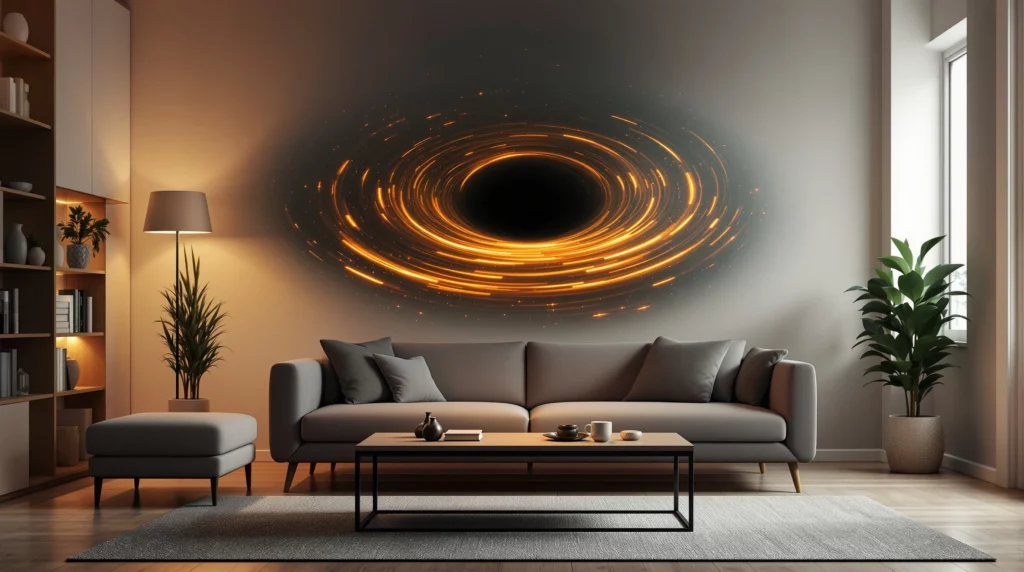
Imagine for a moment that the greatest mysteries of the universe aren’t hiding in the vast depths of space, millions of light-years away. What if they’re actually right here, perhaps even passing through your living room as you read this? It might sound like something out of a science fiction movie, but scientists are seriously considering that tiny, ancient black holes could be much closer to home than we ever imagined.
These aren’t the massive, star-eating monsters we typically think of when we hear “black hole.” Instead, we’re talking about microscopic entities so small they could slip through solid matter without us even noticing. Yet despite their size, they might hold the key to understanding one of the biggest puzzles in physics: what exactly is dark matter?
The Tiny Giants from the Dawn of Time
To understand how these miniature black holes could exist, we need to travel back to the very beginning of everything. Primordial Black Holes, or PBHs as scientists call them, are thought to have formed not from collapsing stars like regular black holes, but from incredibly dense pockets of matter in the early universe, just moments after the Big Bang.
Picture the universe in its infancy, less than a second old. It was a chaotic place, with energy and matter fluctuating wildly. In some regions, matter became so densely packed that gravity took over, crushing it down into black holes. Unlike their stellar cousins, these ancient relics could be surprisingly small, with masses ranging from as light as an asteroid to thousands of times heavier than our sun.
The concept isn’t new. Scientists first proposed the idea over 50 years ago, but what makes it fascinating is that these black holes could still be out there today. They’re considered prime candidates for dark matter, that mysterious substance that makes up about 85% of all matter in the universe but remains completely invisible to us.
The Invisible Tunnelers
Here’s where things get really interesting, and perhaps a little unsettling. Recent theoretical studies suggest that if these primordial black holes exist and are zipping through space at high speeds, they could pass right through solid objects, including planets, buildings, and yes, even your home.
But don’t worry about suddenly being sucked into a cosmic void. These tiny black holes would be moving so fast and be so small that they’d punch through matter like invisible bullets, leaving behind only microscopic evidence of their passage. As physicist Dejan Stojkovic explains, a fast-moving primordial black hole would leave “a remarkably straight, extremely narrow tunnel” as its calling card.
We’re talking about tunnels that are incredibly tiny, about 0.1 microns in diameter. That’s roughly 1,000 times thinner than a human hair. You’d need advanced microscopy equipment to even see the evidence, assuming you knew where to look.
Cosmic Consequences
The implications go far beyond mysterious tunnels in your walls. If a primordial black hole were to encounter a planet or moon with a liquid core, it could potentially become trapped by gravity. Over time, it would slowly consume the liquid interior, essentially hollowing out the celestial body from the inside.
Stojkovic notes that if such an object “has a liquid central core, then a captured PBH can absorb the liquid core, whose density is higher than the density of the outer solid layer.” The result would be a cosmic shell game, where what looks like a solid planet from the outside is actually hollow within.
While the chances of this happening to Earth are extraordinarily small, the possibility has opened up entirely new ways of thinking about how we might detect these elusive objects.
The Great Hunt
Searching for something that’s nearly impossible to see requires creativity. Scientists have developed several ingenious methods to hunt for these cosmic phantoms, each with its own strengths and limitations.
One approach involves looking for the subtle bending of light from distant stars. When a massive object passes between us and a star, it acts like a cosmic magnifying glass, temporarily brightening the star’s light. This technique, called microlensing, has already provided hints that primordial black holes with masses around that of our sun might make up a significant portion of dark matter in our galaxy.
Another method focuses on gravitational waves, the ripples in spacetime that occur when massive objects collide. The detection of these waves by observatories like LIGO and Virgo has revealed black hole mergers that don’t quite fit the conventional models of how black holes form from dying stars. Some of these mysterious mergers could involve primordial black holes instead.
Perhaps most intriguingly, scientists are also looking for Hawking radiation. According to Stephen Hawking’s theories, all black holes slowly evaporate by emitting particles. For primordial black holes, this would include positrons, the antimatter counterparts of electrons. Instruments like the Alpha Magnetic Spectrometer aboard the International Space Station are watching for unusual spikes in positron detection that might signal a primordial black hole in our cosmic neighborhood.
Searching in Your Backyard
But perhaps the most accessible method for detection is also the most surprising: examining old materials right here on Earth. Stojkovic suggests that “examining old materials for microscopic tunnels should be only a small fraction of the cost of building a dedicated astrophysical detector.”
Think about it. If these tiny black holes have been passing through our planet for billions of years, they might have left their mark in ancient rocks, old buildings, or other long-standing structures. Finding these microscopic tunnels would be like discovering fossil evidence of cosmic visitors.
Of course, the challenge lies in distinguishing genuine primordial black hole tracks from all the other ways that tiny holes can form in materials. It’s a needle-in-a-haystack problem, but one that researchers are taking seriously.
Separating Fact from Fiction
Before anyone starts worrying about black holes lurking in their basement, it’s important to address the safety aspect. If primordial black holes do exist and occasionally pass through Earth, they pose absolutely no danger to us or our planet.
These objects would be moving at tremendous speeds, likely tens of kilometers per second, meaning they’d zip through Earth in a matter of minutes. Their gravitational influence would be so localized and brief that we wouldn’t feel a thing. Moreover, the smallest ones would be evaporating due to Hawking radiation, making them even less of a concern.
This is very different from the science fiction scenarios where black holes consume everything around them. The reality is far more subtle and, frankly, far more interesting from a scientific perspective.
The Bigger Picture
The search for primordial black holes isn’t just about satisfying curiosity. These objects could revolutionize our understanding of the universe in several profound ways.
First, if they exist in significant numbers, they could solve the dark matter mystery that has puzzled scientists for decades. Dark matter’s gravitational effects are evident throughout the universe, but its true nature remains one of physics’ greatest unsolved puzzles.
Second, primordial black holes could help explain how supermassive black holes formed so quickly in the early universe. Recent observations by the James Webb Space Telescope have revealed supermassive black holes existing much earlier than conventional theories suggest should be possible. If primordial black holes served as “seeds” for these giants, it would explain this cosmic conundrum.
Finally, studying these objects offers a unique window into the physics of the early universe. They’re like cosmic time capsules, preserving information about conditions that existed when the universe was less than a second old. Understanding them could reveal new physics beyond our current theories.
The Challenge of Detection
Despite all these innovative detection methods, finding definitive proof of primordial black holes remains extraordinarily difficult. The expected rate of detectable events is frustratingly low. Scientists estimate that even in the best-case scenarios, we might see evidence of a primordial black hole passing through our solar system only once per year or even once per decade.
Moreover, many of the signatures we’re looking for could be mimicked by other phenomena. A sudden spike in positrons could come from other cosmic sources. Unusual gravitational effects could be caused by asteroids or space debris. The key is developing detection methods sensitive and precise enough to distinguish the real deal from false alarms.
Current technology is pushing the boundaries of what’s possible, but we’re still in the early stages of this cosmic detective work. Each new observation and theoretical advance brings us closer to either confirming these objects exist or ruling them out entirely.
What This Means for You
So, are there really tiny black holes hiding in your home? The honest answer is: probably not, but it’s not impossible. The universe is vast, and if primordial black holes exist, they’re likely spread very thinly throughout space. The odds of one being in your immediate vicinity at any given moment are astronomically small.
However, over the billions of years that Earth has existed, it’s conceivable that some of these cosmic wanderers have passed through our planet, leaving their microscopic signatures in rocks, minerals, or even ancient human structures. The idea that evidence of the universe’s deepest mysteries might be sitting in a museum display case or embedded in the foundation of an old building is both humbling and exciting.
What’s perhaps most remarkable about this research is how it demonstrates the interconnectedness of the very large and very small, the cosmic and the terrestrial. The same physical laws that govern the formation of galaxies might have left their mark in materials we encounter every day.
Looking to the Future
As our detection methods become more sophisticated and our understanding of primordial black holes deepens, we may finally get the answers we’re looking for. Whether that confirmation comes from space-based detectors, underground laboratories, or careful examination of ancient materials, the discovery would represent a monumental breakthrough in physics.
The study of primordial black holes exemplifies how modern science works at its best, combining theoretical predictions with observational ingenuity and technological innovation. It reminds us that some of the universe’s greatest secrets might not require billion-dollar space telescopes to uncover. Sometimes, the most profound discoveries are hiding in plain sight, waiting for us to develop the right tools and ask the right questions.
As physicist Dejan Stojkovic aptly observed, “The most difficult thing to see is what stands right in front of your nose.” In the case of primordial black holes, what stands in front of our noses might just be the key to unlocking some of the deepest mysteries of existence itself.
Whether or not these tiny cosmic time travelers are actually passing through your home, the search for them is pushing the boundaries of human knowledge and opening up new possibilities for understanding our place in the universe. And that, perhaps, is the most exciting part of the story.